-
8 min read
HumanX conference: How AI is redefining competition


Amsterdam in the fall is lovely. It's better still when people from all over the world land there to talk about where AI is headed.
I spent this past week at HumanX, an AI conference built for business leaders. It brought together executives, founders, and the engineers and infrastructure leaders building this next wave.
Walking into the venue, the design already had something to say. Colors, birds, and nature were everywhere, all built around the idea of bringing things to life, just as we're watching AI edge toward a life of its own. For the first time in history, a computer can act on its own and make decisions against its own command.
What made HumanX different
HumanX drew about 2,500 people to Amsterdam's RAI center. What set it apart was how much it centered its speakers, with portraits of every presenter greeting you the moment you walked in.
Most conferences run on one stage, with a rotating set of speakers across a single day. HumanX ran five stages at once, each carrying the same caliber of speaker: CEOs, CTOs, founders, and the people building this industry. That structure gave far more people a real shot at sharing their perspective, and far more people showed up ready to listen.

One of the HumanX stages, with great speakers talking where AI is headed.
AI has stopped being one industry's conversation. The topics at HumanX proved it:
- Manufacturing companies building AI directly into their products
- Cloud spend and economics, where our team spent most of our time
- Healthcare organizations rethinking clinical work and operations with AI
- Retail and consumer brands rebuilding how they reach and understand customers
- Finance teams automating everything from reporting to how money moves
- A wide range of other conversations, each treating AI as core to their business rather than a side experiment
That breadth made it clear that we’re all experiencing the same shift.
In an AI-first market, speed is the real advantage
One idea from HumanX has stuck with me since I flew home: the definition of a moat in technology is changing, and most companies have not caught up to it yet.
Building used to be the hard part. If a company built something real, that difficulty was the moat, since it was not easy for anyone else to build it too.
AI has erased that advantage. Building is easy now, for almost anyone with the right tools.
I heard this argument made best by Arvind Jain, founder of Glean and my old CEO, in a session called “Beyond the Token Race” with Harry Booth, reporter at TIME. Glean is an enterprise AI assistant that learns your role, the documents you touch, and the people you talk to, then shapes what it surfaces around that.
Harry asked him the question everyone in the room was likely thinking. Claude can now do most of what Glean does, connecting to Slack, HubSpot, Salesforce, and Google Drive. So what is Glean's differentiator? What is its moat?
His answer was direct: speed is the new moat.
Instead of the ability to build, what matters now is how fast you adapt as the tools around you change. A company that built its product five years ago, on older technology, is not protected by that history. If it is not building on today's tools, its own past success works against it.
That reframes what an edge even is. Competitive advantage used to be technical, something only a few people or companies could reach. To me, that edge is now human. It comes down to how fast you notice what is happening, how well you understand the problem in front of you, and how consistently you keep adapting.
That is the kind of edge I have spent my career building, long before AI made it the whole game.
This is something sales teaches you early

From left to right: Gopal Trivedi, Jordan Wayne, and Alekya Putta, all great members of North’s GTM team at the HumanX conference.
There is an old phrase in sales I have carried for most of my career: time is the enemy of every salesperson. We get about 61 selling days in a quarter, and every one that passes without progress works against us. We spend that time trying to close the quarter, then trying to close the year, always racing a clock that never stops.
Time with customers is even more limited, a single conversation or meeting, and then it closes. So every bit of that time goes toward what actually moves the deal, the account, or the quarter.

Gopal Trivedi, VP of Sales at North.cloud, at HumanX Amsterdam.
That is what speed has always meant to me, spending limited time where it creates the most value, without hesitation. Hearing that same principle described as the future of competitive advantage, in a room full of founders, engineers, and operators, did not feel foreign. It felt like something a lot of people are only now discovering, that some of us have been living inside for a long time.
How North turns speed into real savings
Everyone is racing for speed, but AI's costs are surging. Where is that money supposed to come from?
It does not appear out of nowhere. Fast-growing companies can absorb the cost more easily. Yet companies with steady, ordinary growth have to find that money somewhere else, usually in savings and efficiencies they are already sitting on.
That is where North operates. We built a new model for finding that money across a company's cloud, data, and AI spend.
The old way: slow, expensive, engineering-led
Most cost optimization work happens inside engineering, and it happens slowly:
- Engineers size the environment and evaluate new technology
- Every option gets tested for price and performance
- The winning solution gets procured, deployed, and adopted into the workflow
Each step costs something. Budget, people, and often months or years before the savings actually show up.
The North way: fast, self-funding, no lift required
North collapses that entire timeline. There is no engineering team to staff and no long adoption curve before the value shows up.
We plug into a company's environment, with no setup work required from their team. Once we are in, we find where infrastructure is oversized or inefficient, lock in the best pricing on committed spend automatically, and catch spend spikes before they become a problem.
There is no budget needed upfront, since we only get paid after we have already saved the company money. On average, we cut a customer's cloud bill by 30%, and I do not know another company that delivers that consistently, customer after customer, as the default rather than the exception.
Why this matters even more for AI-native companies
Many or most of North's customers today are AI-native, meaning their product runs on some level of inference. That distinction changes what savings actually mean for them.
For a typical company, cloud spend sits under general and administrative costs. For an AI-native company, it is the direct cost of the product itself.
That difference shows up clearly in gross margin:
| Typical SaaS company | AI-native company | |
|---|---|---|
| Gross margin | 70 to 80% | Around 50% |
| Why | Software costs are largely fixed | Compute, tokens, and cloud spend scale with usage |
Reducing cloud spend for an AI-native company directly improves the margin profile of their product.
When I think about speed now, this is what it means to me: how fast can I turn savings into growth. I cannot think of a better way to do that than what North already does every day.
Where this is all headed
There is a bigger shift underneath all of this that many are talking about.
Right now, a company buying cloud, AI, and data infrastructure has to manage all of it separately. Cloud from one vendor, AI spend from another, data platforms from a handful more. Someone has to track usage, manage licensing, and make sure the company is neither overspending nor underspending on each one.
That is a lot of separate decisions for one company to manage well.
I think the next five years look different, with AI agents handling procurement for cloud, tokens, and data platforms instead of people. In some cases, they will be negotiating with other AI agents on the other side of the transaction.
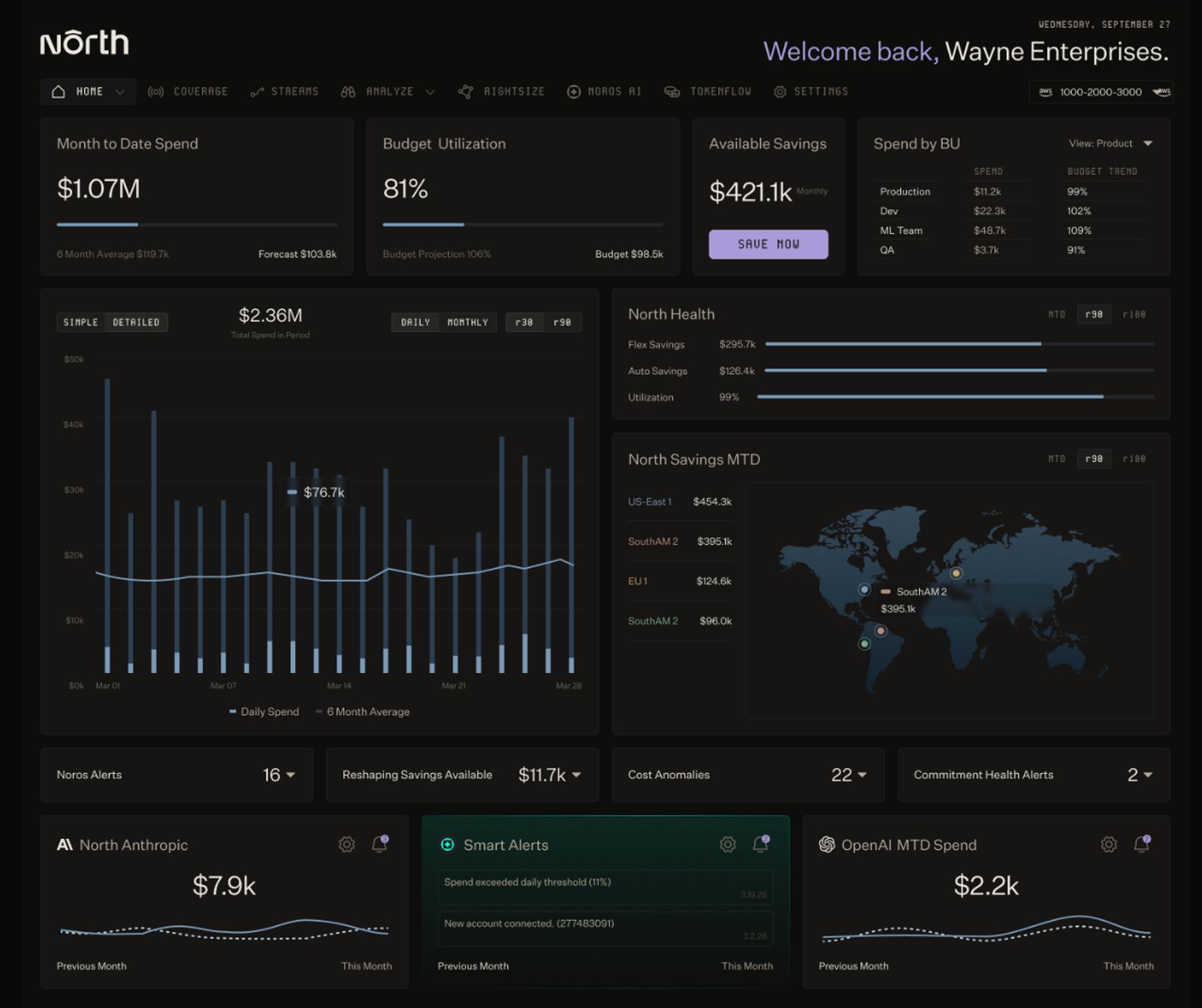
North's app main dashboard showing cloud, AI and data spend all in the same view.
That is the future North is building toward: a single platform that can serve as the finance layer underneath that shift, built for a world where buying decisions increasingly happen at machine speed, not human speed.
Speed is still the whole game
Everything I saw at HumanX pointed back to the same idea. The moat that used to protect a company, the thing that made it hard to catch, is not what it used to be.
What replaces it is speed, how fast a company notices what is changing, and how fast it moves once it does.
That is the standard I hold myself to every day, in sales and in how I think about North. We are growing 3x year over year, and the only way to keep that pace is to keep our own speed up, in how we build, how we sell, and how we help our customers move.
The companies that win the next few years will be the ones who never stop moving.
Explore North's free tier to see how much speed it can give your team.
FAQs
Answers to common questions covered in this post.
What is HumanX?
HumanX is an AI conference built for business leaders, bringing together executives, founders, and the people building the next wave of AI infrastructure. The event runs across multiple locations, including an edition held in Amsterdam.
How does North help companies reduce cloud costs?
North connects to a company's cloud environment and finds where infrastructure is oversized or inefficient, locks in better pricing on committed spend, and catches spend spikes early. North only gets paid after it has already delivered savings, so there is no budget required upfront.
How does North save companies time, not just money?
Traditional cost optimization requires engineering teams to evaluate technology, test it, and adopt it into their workflow, a process that can take months or years. North replaces that cycle with continuous, automated work: finding oversized or inefficient infrastructure, securing better pricing on committed spend, and catching spend spikes as they happen, all without a team having to manage the process. Companies get the savings without spending the time it would normally take to find them.
How much can companies save on their cloud bill with North?
On average, North reduces a customer's cloud bill by 30%, with some customers seeing savings of up to 50%.
How much has North saved customers overall?
North currently manages more than $2 billion in cloud spend across its customer base and has saved customers over $400 million so far.
Why does cloud spend matter more for AI-native companies?
For a typical software company, cloud spend is a general and administrative cost. For an AI-native company, whose product runs on inference, cloud spend is a direct cost of goods sold. Reducing cloud spend for an AI-native company directly improves its gross margin, not just its overhead.